
Estimates based on Wisconsin market data and regional freeze-thaw damage patterns. Get a professional inspection for accurate assessment.
Road Salt: Wisconsin Concrete's Silent Killer
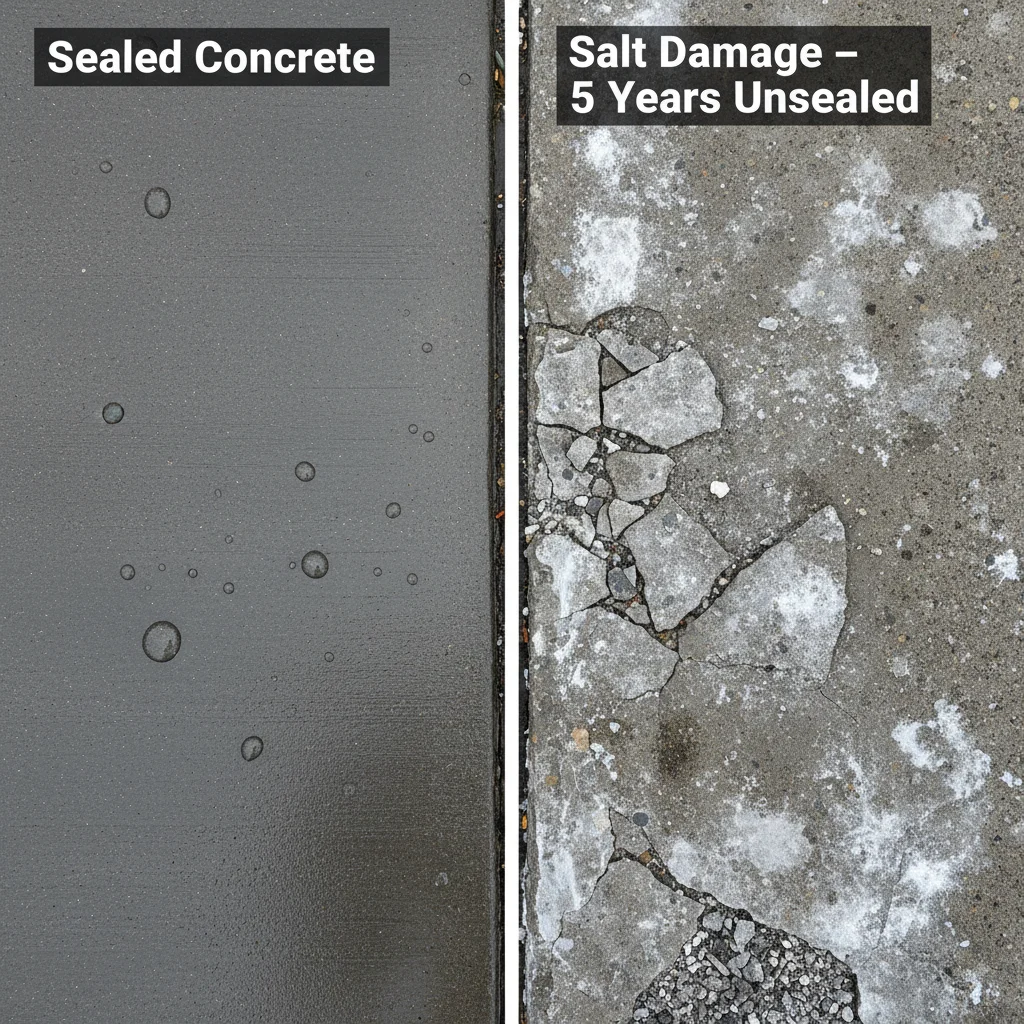
De-icing salt (sodium chloride) lowers water's freezing point, allowing it to penetrate deeper into concrete before freezing. The resulting expansion damages the concrete from within. Calcium chloride — common in Wisconsin municipal applications — is even more corrosive, penetrating paste and attacking the C-S-H matrix directly.
After just 5 years of heavy salt exposure, surface scaling becomes visible on unsealed concrete. The damage is cumulative and irreversible — once aggregate is exposed at the surface, moisture penetration accelerates and the cycle compounds with each Wisconsin winter.
WI specific: Milwaukee and Madison average 70–90 freeze-thaw cycles per year. Fox Valley runs 80–100. Each cycle widens existing cracks as water expands 9% when it freezes.
How Many Cycles Your Concrete Survives
Milwaukee and Madison sit in the 70–90 freeze-thaw cycle range annually. Fox Valley runs higher at 80–100 cycles. Each cycle stresses the concrete matrix — water expands 9% when it freezes, creating microcracks that widen over time.
Air-entrained concrete handles this well — the microscopic air bubbles act as relief valves, giving freezing water space to expand without cracking the paste. Unsealed concrete without air entrainment fails much faster — microcracks become visible surface cracks within 3–5 years under Wisconsin conditions.
Catching the Repair Window Before It Becomes Replacement
The difference between a $300 seal job and an $8,000 replacement is often just 2–3 Wisconsin winters. Here's the damage escalation timeline.
The repair window is real and time-limited in Wisconsin. Resurfacing at $3–5/sqft catches the window between hairline cracks and full replacement. Miss it by one or two winters and you're looking at $6–11/sqft for a full pour.
Wisconsin Concrete Sealer: When and What to Use
A penetrating silane-siloxane sealer is the single best investment to extend concrete life in Wisconsin. Here's the right process.
New concrete needs to cure fully before sealing. Sealing too early traps bleed water and causes white haze.
Pressure wash + degrease. Any oil, stains, or efflorescence must be removed or the sealer won't bond.
Soaks into the pores rather than forming a surface film. Not slippery when wet — correct for WI driveways.
October timing is ideal — dry concrete, before first freeze. Watch for water no longer beading as the signal to reseal.
October is the best time to seal in Wisconsin — before first freeze, on dry concrete. Avoid film-forming acrylic sealers on driveways; they get slippery when wet in WI winters. Use penetrating silane-siloxane or siliconate instead. See our concrete maintenance guides → for more detail.