



When Stamped Concrete Makes Sense for Your Project
You're looking at concrete anyway — why not make it look better? Stamped concrete works when you want decorative appeal but need to stay on budget. It's especially smart for large areas like driveways and pool decks where natural materials become prohibitively expensive.
Best applications: patios, pool surrounds, front walkways, driveways, interior floors. Poor fits: areas with frequent heavy loads (commercial truck traffic), surfaces that can't be properly prepared, or projects that need installation in under-50°F weather.
Wisconsin challenges require Wisconsin solutions. Your stamped concrete needs air-entrainment (5-7% air content) to survive freeze-thaw cycles and compatible sealers to resist road salt damage.[1]
Consider stamped concrete when you're planning new construction or replacing failing surfaces. Retrofitting over existing concrete rarely works — the stamps need a fresh pour to create authentic texture depth. Madison and Milwaukee homeowners frequently choose stamping for front entry upgrades where curb appeal matters but budgets don't allow for bluestone or slate.
Color longevity depends on your choice: integral colors mixed into the concrete resist UV fade far better than surface stains, which may require touch-ups every few years in direct sun exposure.[2]
What Does Stamped Concrete Cost in Wisconsin?
Expect $12-$25 per square foot installed for most residential projects. That covers materials, labor, and sealing. Your final cost depends on pattern complexity, color choices, and site accessibility.
Cost Drivers That Increase Your Quote
Site factors: Difficult access, extensive excavation, or steep slopes add $2-5/sqft. Color upgrades: Integral color throughout costs $0.50-1.50/sqft more than gray base with surface release. Decorative borders: Contrasting patterns or hand-tooled edges add $8-15 per linear foot.
Stamped Concrete vs Alternatives
The value proposition: Stamped concrete achieves 40-60% cost savings versus natural stone while delivering similar visual impact.[3] A 400-sqft patio runs $4,800-10,000 stamped versus $10,000-20,000 in natural flagstone. For Milwaukee or Oshkosh homeowners with larger driveways, that difference becomes substantial.
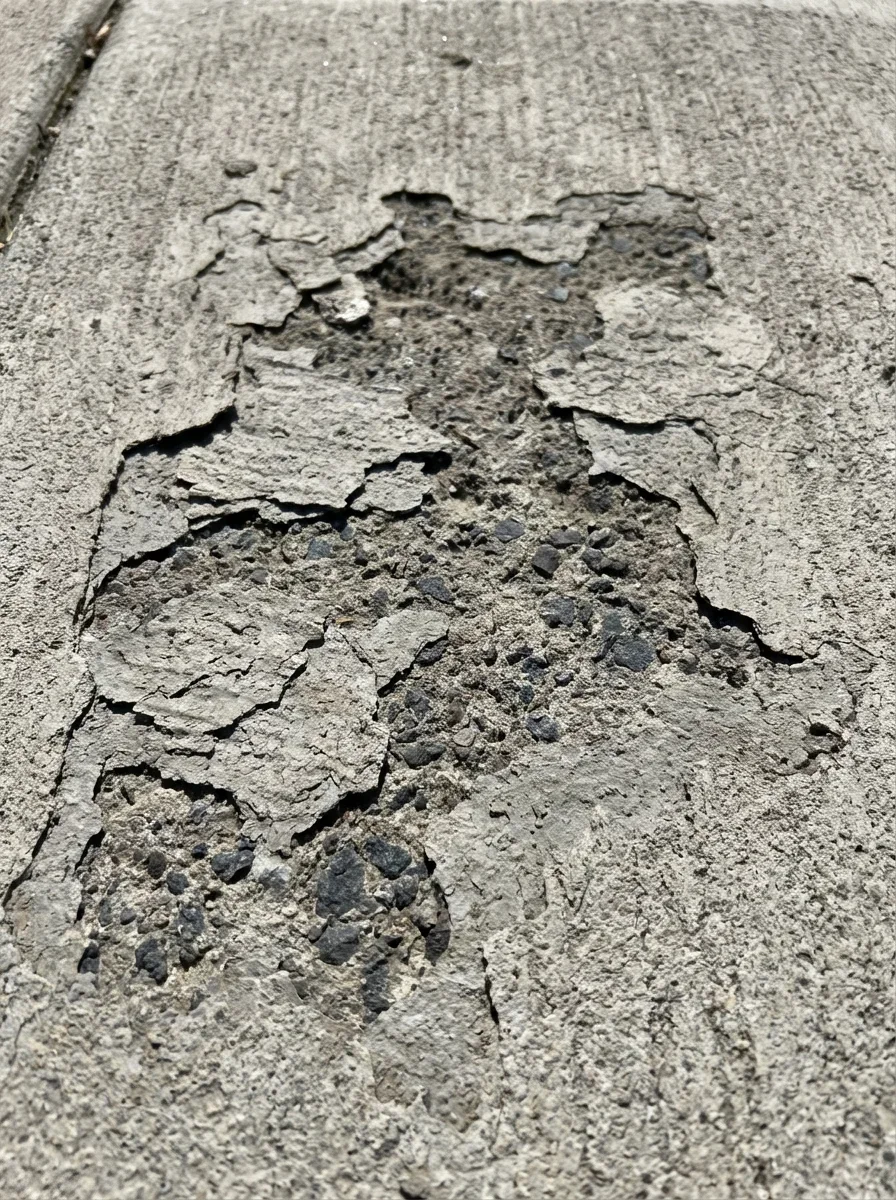
Maintenance costs matter too. Budget $200-400 every 2-3 years for professional resealing to maintain appearance and protection. Skip the sealer, and you’ll see color fade and salt damage within one harsh Wisconsin winter.
How Stamped Concrete Installation Works
The process looks simple — it isn't. Quality stamping requires precise timing, the right weather, and experienced hands.
Surface Prep and Pouring
- Excavation and base preparation: Remove existing surface, compact 4-6 inches of granular base
- Forming and reinforcement: Set forms, install wire mesh or rebar (required for driveways)
- Concrete placement: Pour 4-inch minimum thickness with air-entrained mix designed for Wisconsin freeze-thaw[3]
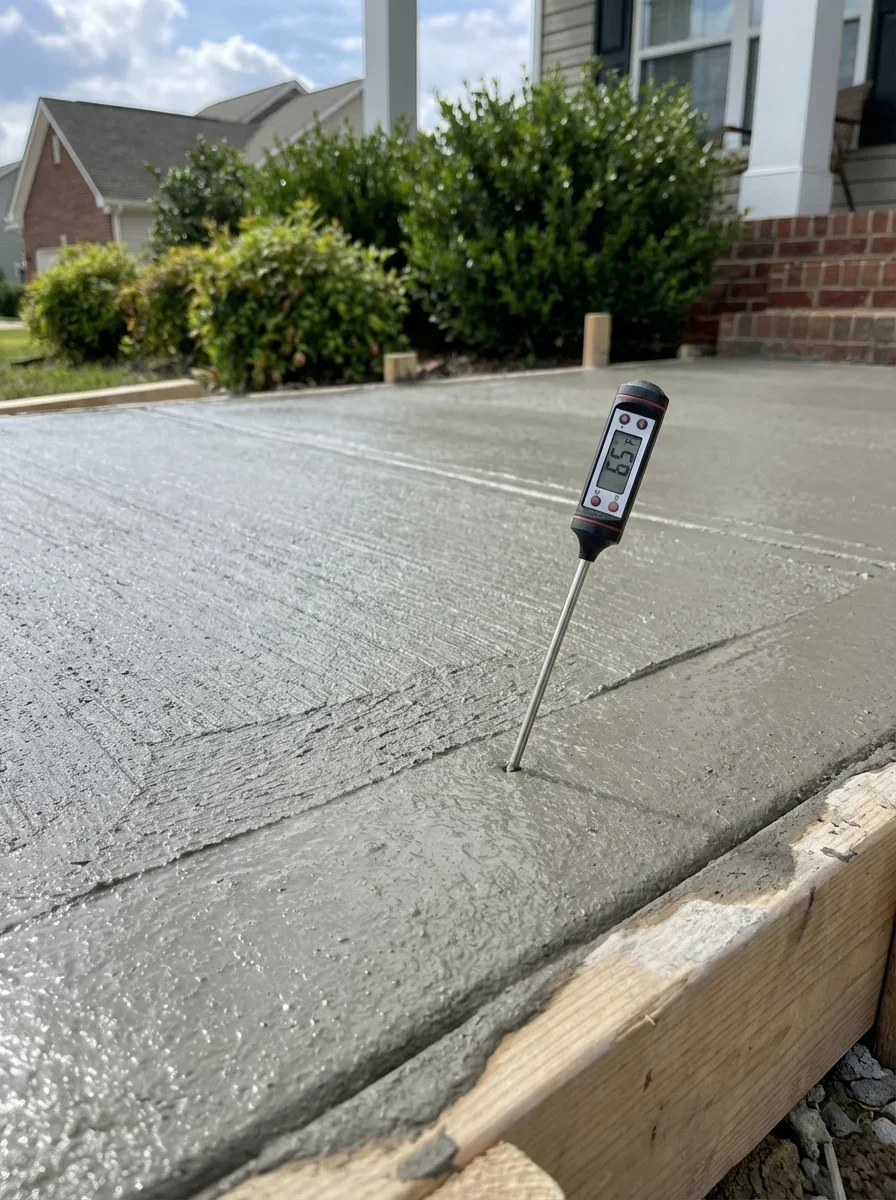
Temperature requirement: Stamping needs air temps above 70°F and concrete surface temps in the ideal working range. Spring and fall installations in Green Bay or Appleton require careful weather monitoring — a cold snap during curing ruins the finish.[2]
Stamping and Coloring Technique
The contractor has a narrow 2-4 hour window after pour to stamp. Too early, the stamps sink too deep. Too late, they won't impress.
- Release agent application: Powder or liquid prevents stamps from sticking while adding accent color
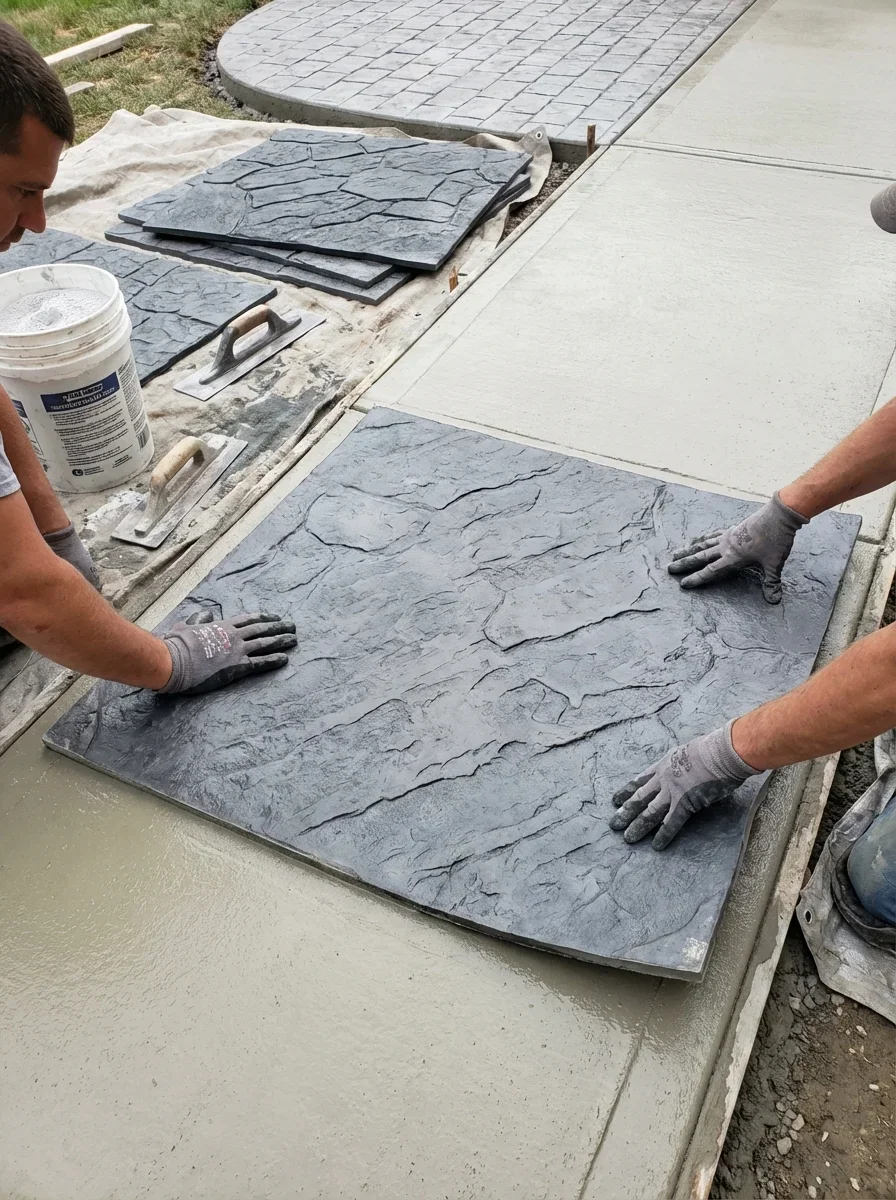
- Pattern stamping: Crew works systematically across the surface, pressing texture mats into concrete
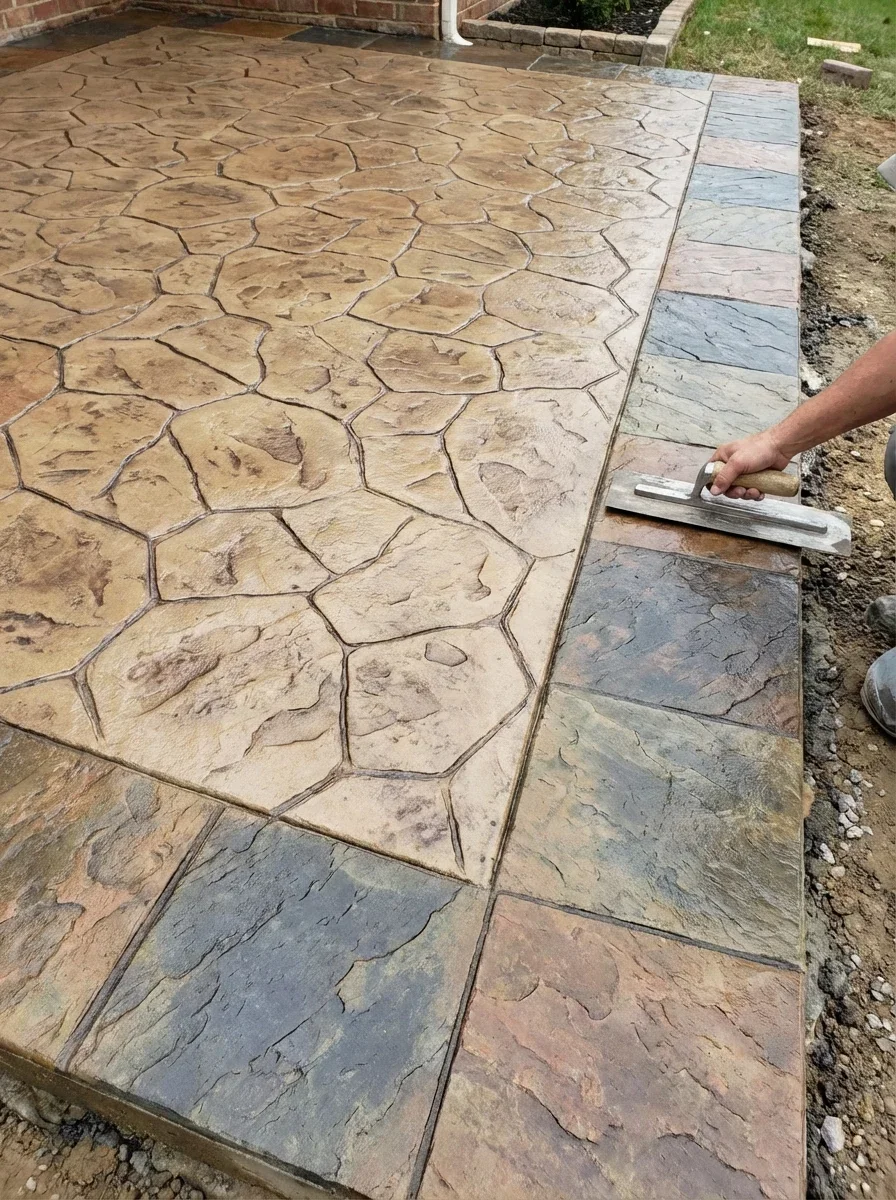
- Detail work: Hand tools create grout lines and texture in tight corners
Sealing and Curing Requirements
Fresh stamped concrete needs 3-5 days minimum cure before foot traffic, longer for vehicles.[2] Professional sealing happens after 28 days of full cure. That sealer protects your investment from moisture intrusion, salt damage, and UV fade — but it requires reapplication every 2-3 years in Wisconsin's climate.
How to Choose a Stamped Concrete Contractor
Quality stamping work requires experience you can see. Bad stamping looks fake, wears poorly, and can't be easily fixed.
Questions to Ask
- Can I see photos of your Wisconsin projects 3-5 years after installation? You want to verify how their work weathers, not just how it looks fresh.
- What air-entrainment percentage do you specify? Correct answer: 5-7% for freeze-thaw durability.[1]
- Which sealer do you use and what's the reapplication schedule? They should specify the product and back it with clear maintenance guidance.
- Do you pour and stamp in-house or subcontract? The best stampers control the entire process.
- What happens if color fades or the sealer fails? Get warranty terms in writing.
- Can you match this pattern to my existing hardscape? Bring photos of materials you want to complement.
Red Flags
- Unwillingness to stamp samples in current weather conditions — temperature matters
- No discussion of air-entrainment or Wisconsin-specific mix design — they don't understand cold climate concrete
- Pressure to stamp in marginal weather ("we can make it work") — recipe for failure
- Vague timeline or rush scheduling — quality stamping can't be rushed
Wisconsin licensing: Concrete contractors don't need state licensing, but they should carry general liability insurance (minimum $1M) and workers' comp. Ask for certificates.
Compare portfolios in Badger Flatwork's directory with attention to pattern variety and project scale. The contractor who stamped a 150-sqft walkway may not have the crew or expertise for your 1,200-sqft driveway.
Frequently Asked Questions
No, stamped concrete is more expensive than plain concrete due to added labor for coloring and texturing. Plain concrete costs $6-15/sq ft while basic stamped runs $10-18/sq ft. However, stamped concrete is significantly cheaper than pavers ($25-60+/sq ft) while mimicking their look.
- Wisconsin Department of Transportation. "Concrete Pavement Design, Construction and Performance." https://wisconsindot.gov/dsdmanuals/constpubs/clm/ch12.pdf. Accessed February 24, 2026.
- Concrete Network (industry publication by Northwest Cement Council). "Stamped Concrete Guidelines." https://www.concretenetwork.com/stamped_concrete/guidelines.html. Accessed February 24, 2026.
- Portland Cement Association. "Guide to Durable Concrete Parking Lots and Driveways." https://www.cement.org/docs/default-source/fc_concrete_technology/is406-09.pdf. Accessed February 24, 2026.