
Why Foundations Crack
Every poured concrete foundation develops cracks. Concrete shrinks as it cures, and that shrinkage has to go somewhere. The question isn't whether your foundation will crack — it's whether those cracks indicate normal behavior or a structural concern.[1]
Beyond normal shrinkage, several forces can cause or worsen foundation cracking:
- Soil settlement beneath or around the foundation
- Hydrostatic pressure from water-saturated soil pushing against basement walls
- Frost heave from Wisconsin's 48-inch frost line affecting shallow footings
- Tree roots exerting lateral pressure against foundation walls
- Poor drainage directing water toward the foundation
Types of Foundation Cracks and What They Mean
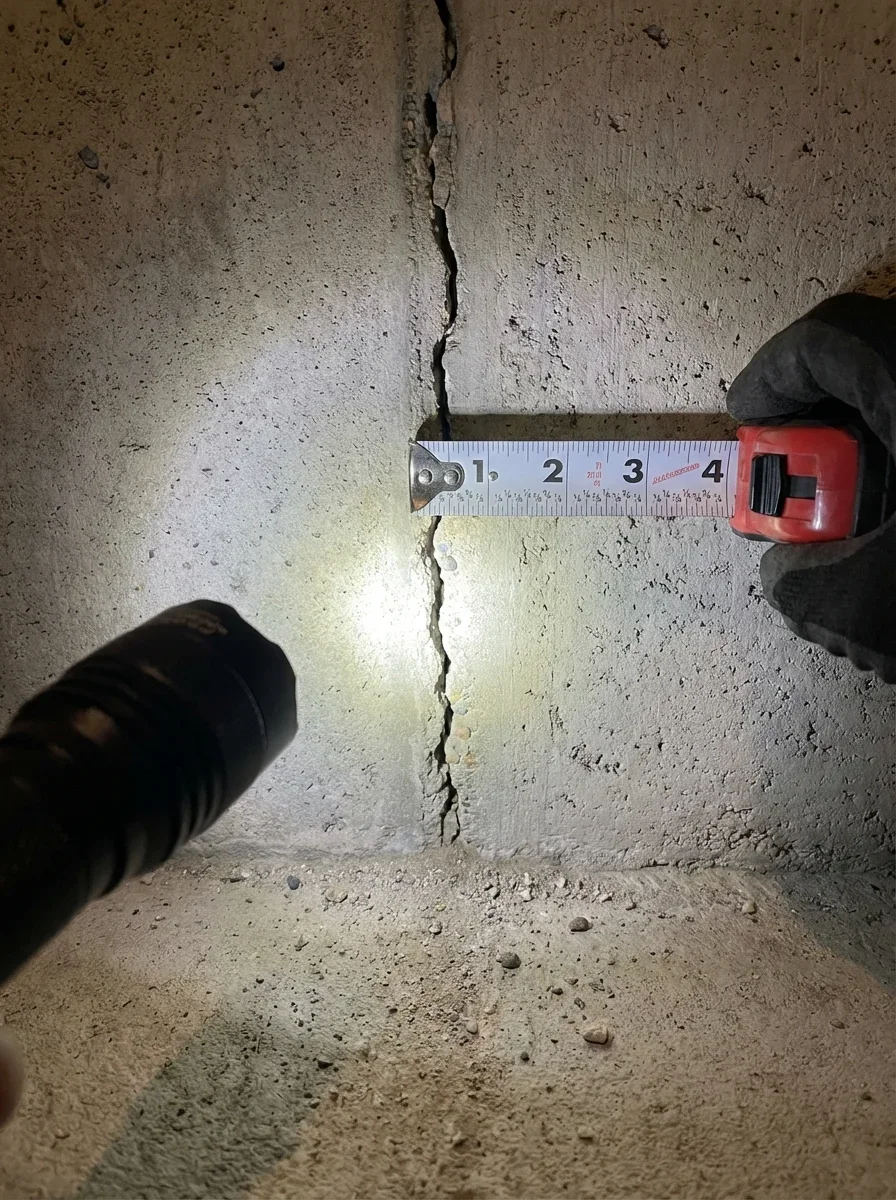
The single most important thing about a foundation crack is its orientation. Vertical, horizontal, and diagonal cracks each tell a very different story.
Vertical Cracks
Vertical cracks (running straight up and down) are the most common type and generally the least concerning. They typically result from concrete shrinkage during curing and rarely indicate structural movement.[2]
If a vertical crack is hairline-thin and hasn't changed since the house was built, it's almost certainly cosmetic. You may want to seal it to prevent water intrusion, but it's not a structural issue.
Diagonal Cracks
Cracks running at a 30-60 degree angle usually indicate differential settlement — one part of the foundation is settling faster or farther than another. These deserve attention, especially if they're wider at one end than the other.
Diagonal cracks often appear near corners of windows and doors in the foundation wall, where stress concentrates. They may also indicate that the soil bearing capacity varies under different parts of the foundation.
Horizontal Cracks
Horizontal cracks are the ones that warrant immediate professional attention. A horizontal crack in a foundation wall means lateral pressure from the outside is pushing the wall inward. In Wisconsin, this is often caused by saturated soil freezing and expanding against the wall, or by poor drainage creating persistent hydrostatic pressure.[3]
A bowing or inward-leaning wall with a horizontal crack is a structural concern that needs engineering evaluation — not just a patch.
| Crack Type | Direction | Typical Cause | Severity | Action Needed |
|---|---|---|---|---|
| Vertical hairline | Up/down, < 1/16" | Curing shrinkage | Low | Seal to prevent water entry |
| Vertical, wider | Up/down, > 1/8" | Settlement or pressure | Moderate | Monitor and assess |
| Diagonal | 30-60 degree angle | Differential settlement | Moderate to High | Professional assessment |
| Horizontal | Side to side | Lateral soil/frost pressure | High | Structural engineer — urgent |
| Stair-step (block walls) | Follows mortar joints | Settlement or pressure | Moderate to High | Professional assessment |
When to Worry
Not every crack needs an emergency call. Here's how to gauge the urgency.
Monitor but don't panic:
- Hairline vertical cracks that haven't changed
- Cracks at corners of windows or doors that are stable
- Minor stair-step cracking in block walls without bowing
Get a professional assessment soon:
- Any crack wider than 1/4 inch
- Cracks that are actively growing (mark them and check monthly)
- Diagonal cracks wider at one end
- Water actively leaking through a crack
- Multiple cracks appearing in a pattern
Call a structural engineer now:
- Horizontal cracks at any width
- Wall bowing, leaning, or shifting inward
- Cracks with significant vertical or horizontal displacement
- Foundation movement visible from outside (separation from sill plate, gaps)
How to monitor a crack: Place a pencil mark at each end and note the date. Measure the width with a ruler or crack gauge card. Check again in 30, 60, and 90 days. If it's growing, bring in a professional. If it's stable for a full season (including a Wisconsin freeze-thaw cycle), it's likely dormant.
Foundation Crack Repair Methods
The repair approach depends entirely on what's causing the crack and how severe it is.
Epoxy or Polyurethane Injection
For stable, non-structural cracks, injection fills the crack from the inside and restores the wall's water resistance. Epoxy creates a rigid bond; polyurethane stays flexible to accommodate minor movement.
Best for: Vertical shrinkage cracks, water seepage through stable cracks.
Carbon Fiber Reinforcement
Carbon fiber straps or sheets are epoxied to the interior face of the wall to add tensile strength. This is often used for walls with early-stage bowing or horizontal cracking that hasn't progressed significantly.
Best for: Walls with minor inward movement (less than 2 inches of bow).
Wall Anchors or Braces
Steel anchors are driven through the wall into the soil outside, then tightened to stabilize (and sometimes gradually straighten) a bowing wall. Steel I-beam braces provide a similar function from the interior.
Best for: Moderate to significant wall movement, horizontal cracking with measurable bowing.
Full Foundation Repair or Replacement
In extreme cases — severe structural compromise, major settlement, or deteriorating foundation material — sections of the foundation may need to be rebuilt. This is major work involving excavation, shoring, and re-pouring.
Best for: When other methods cannot restore structural integrity.
The Role of Water Management
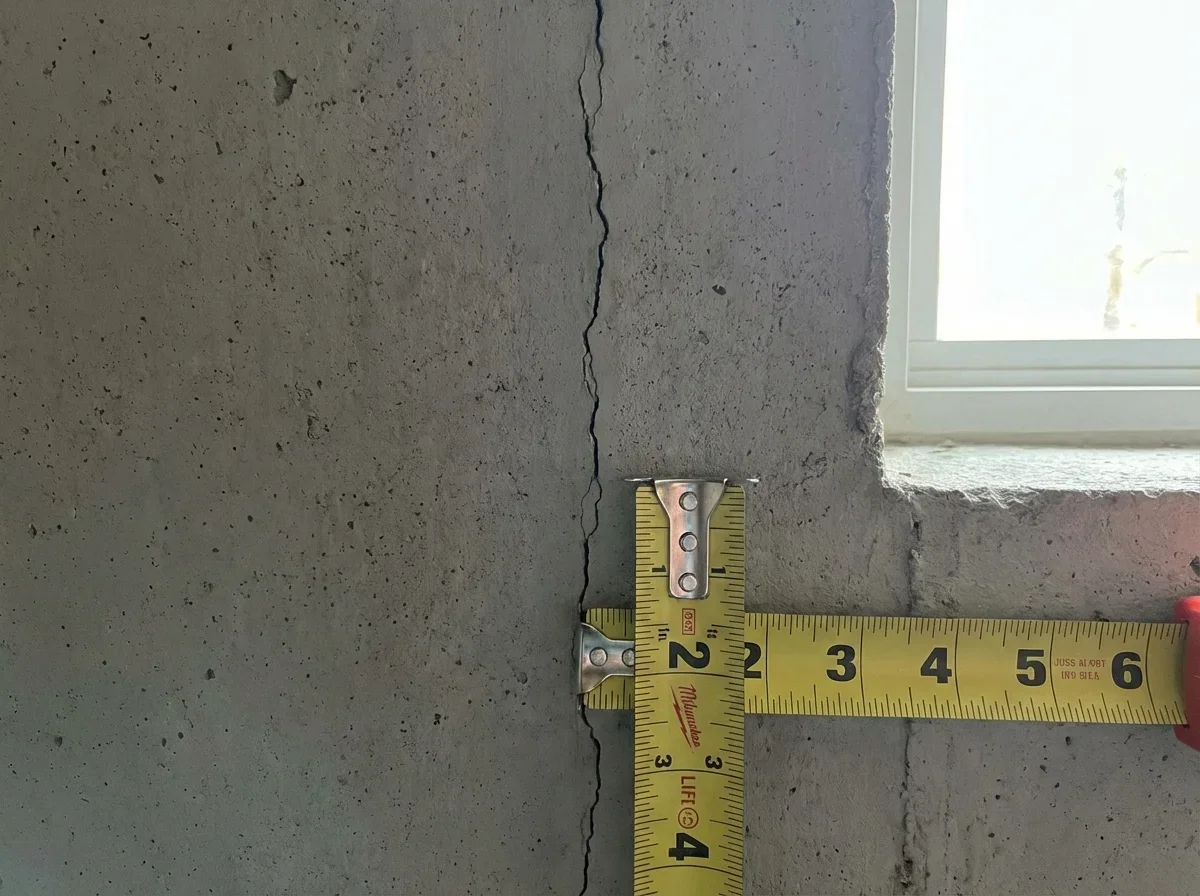
A surprising number of foundation problems trace back to water. Soil that stays saturated against a foundation wall exerts tremendous lateral pressure — and when that wet soil freezes in a Wisconsin winter, the force increases significantly.
Before (or alongside) any crack repair:
- Ensure gutters are clean and downspouts extend 4-6 feet from the foundation
- Grade the soil so it slopes away from the house (minimum 6 inches of fall in the first 10 feet)
- Check for any plumbing leaks near the foundation
- Consider interior or exterior drain tile if water infiltration is chronic
Fixing the crack without fixing the water is treating the symptom, not the cause.
Frequently Asked Questions
- Portland Cement Association. "Cracks in Basement Walls." cement.org. Accessed February 8, 2026.
- International Code Council. "IRC Section R404 — Foundation and Retaining Walls." iccsafe.org. Accessed February 8, 2026.
- University of Minnesota Extension. "Moisture in Basements: Causes and Solutions." extension.umn.edu. Accessed February 8, 2026.