
Why Concrete Driveways Crack
Every concrete driveway will crack eventually. It's not a question of if — it's a question of when and how badly. Concrete is incredibly strong under compression, but it has very little tensile strength. When forces pull or push unevenly, something has to give.[1]
In Wisconsin, the freeze-thaw cycle is the single biggest driver of driveway damage. Water seeps into tiny pores and existing micro-cracks, freezes and expands by about 9%, then thaws. That cycle can repeat dozens of times each winter.[2]
Other common causes include poor subgrade preparation, tree root pressure, heavy vehicle loads, and concrete that cured too quickly during placement.
Types of Driveway Cracks
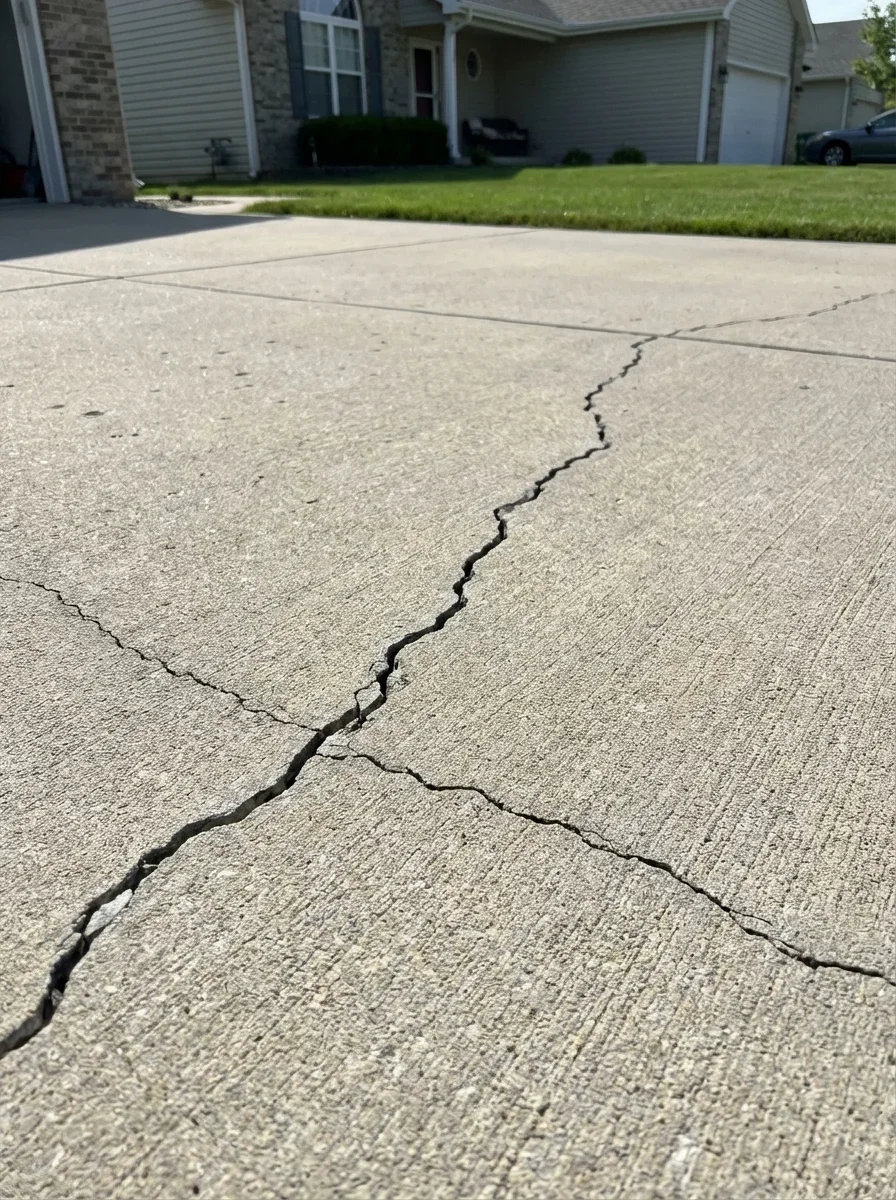
Not all cracks are created equal. The pattern, width, and location tell you a lot about what's going on.
Hairline Cracks
These are thin surface cracks, usually less than 1/8 inch wide. They're mostly cosmetic and often result from shrinkage as the concrete cures. They rarely indicate structural problems, but they do give water a path into the slab.
Linear or Longitudinal Cracks
Straight cracks running along the length of the driveway typically follow control joints that weren't cut deep enough — or weren't cut at all. They're the slab cracking where it wanted to, rather than where you planned.
Pattern or Map Cracking
A network of interconnected cracks that looks like a dried-up riverbed. This usually points to a mix design issue or surface that dried out too fast during finishing. It's often shallow, but widespread pattern cracking can signal bigger problems.
Heaving Cracks
When one side of the crack is higher than the other, you've got movement underneath. In Wisconsin, frost heave is the usual suspect — the frost line sits at 48 inches, and shallow footings or poor drainage can push slabs upward during winter months.
| Crack Type | Width | Typical Cause | Severity |
|---|---|---|---|
| Hairline | < 1/8" | Shrinkage during curing | Low — cosmetic |
| Linear | 1/8" – 1/4" | Missing or shallow control joints | Low to Moderate |
| Pattern/Map | Varies | Poor mix or rapid surface drying | Moderate |
| Heaving | Any width, offset | Frost heave or root pressure | High — structural |
| Wide/Growing | > 1/4" and expanding | Settlement or subgrade failure | High — structural |
When Repair Makes Sense
Crack repair is the right call when the damage is mostly cosmetic and the slab underneath is still stable. A few good candidates for repair:
- Hairline cracks that haven't widened over time
- Single cracks less than 1/4 inch wide with no vertical offset
- Surface-only damage with the slab still level and solid
For narrow cracks, a quality polyurethane or epoxy filler works well. For cracks up to about 1/2 inch, a flexible concrete caulk handles seasonal expansion and contraction better than rigid fillers.
The key word is stable. If the crack hasn't changed in a year or two, filling it prevents water intrusion and keeps things from getting worse.
When Replacement Is the Better Investment
There's a tipping point where patching stops making financial sense. You're throwing good money after bad if:
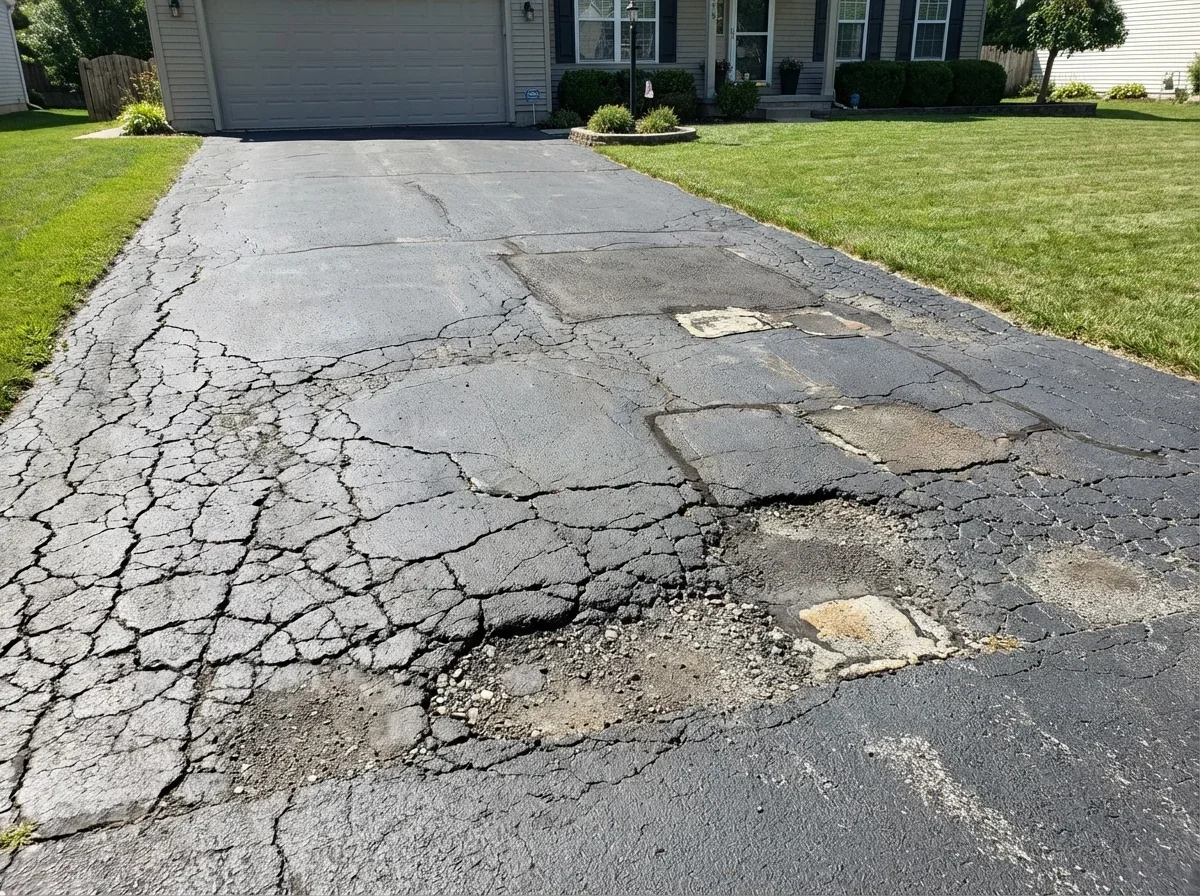
- Cracks cover more than 25-30% of the driveway surface
- The slab has settled or heaved, creating uneven sections
- Multiple areas are crumbling or spalling alongside the cracks
- The driveway is over 25 years old with recurring problems
- Previous patches have failed or new cracks keep forming
Rule of thumb: If the cost of repairs exceeds 40-50% of replacement cost, tear-out and repour is usually the smarter long-term move. A new properly-installed driveway should give you 25-30 years of solid service.
The Repair vs Replace Decision
Ask yourself three questions:
Is the base stable? If the ground underneath has shifted, eroded, or was never properly compacted, surface repairs won't hold. You'll be back to square one within a season or two.
Are the cracks active or dormant? Mark the ends of your cracks with a pencil and check them in a few months. If they're growing, surface filler is a temporary fix at best.
What's the slab's overall condition? One crack in an otherwise solid driveway is very different from one crack in a driveway that's also spalling, settling, and 30 years old.
DIY Fixes vs Professional Repair
Small hairline cracks are reasonable DIY territory. Pick up a concrete crack filler at the hardware store, clean out the crack with a wire brush, and apply per the directions. It's a Saturday afternoon project.
Anything beyond that — wide cracks, structural movement, settling — benefits from a professional eye. A contractor can assess what's happening below the surface, evaluate the subgrade, and recommend the right fix rather than a band-aid.
Preventing Future Cracks
Whether you repair or replace, a few steps go a long way toward extending the life of your driveway:
- Seal the surface every 2-3 years to reduce water penetration
- Keep drainage flowing away from the slab — clean gutters, grade the yard
- Use sand instead of rock salt for ice management when possible (salt accelerates surface damage)[3]
- Cut control joints properly on new pours — every 8-12 feet in each direction
- Avoid parking heavy equipment in the same spot repeatedly
Catching cracks early and addressing them before water gets underneath is the single best thing you can do. A $20 tube of filler today can prevent a $5,000 replacement down the road.
Frequently Asked Questions
- Portland Cement Association. "Types and Causes of Concrete Cracks." cement.org. Accessed February 8, 2026.
- American Concrete Institute. "Guide to Durable Concrete — ACI 201.2R." concrete.org. Accessed February 8, 2026.
- University of Minnesota Extension. "Using Salt and Sand for Winter Road Maintenance." extension.umn.edu. Accessed February 8, 2026.