
Stamped Concrete Pricing Breakdown
The price of stamped concrete depends on three main factors: pattern complexity, number of colors, and project size. Here is how those factors stack up:
| Complexity Level | Description | Cost Per Sq Ft |
|---|---|---|
| Basic (1 pattern, 1 color) | Single stamp pattern with integral color | $10 - $12 |
| Mid-range (1 pattern, 2 colors) | Stamp pattern with base color + release agent highlight | $12 - $15 |
| High-end (2+ patterns, 2-3 colors) | Multiple patterns, borders, hand-applied color accents | $15 - $18 |
| Premium custom | Seamless textures, multi-color hand staining, inlays | $18 - $25+ |
Most residential projects fall in the $12 to $15 per square foot range. That typically gets you a single ashlar slate or cobblestone pattern with a contrasting release color.
Popular Stamped Concrete Patterns
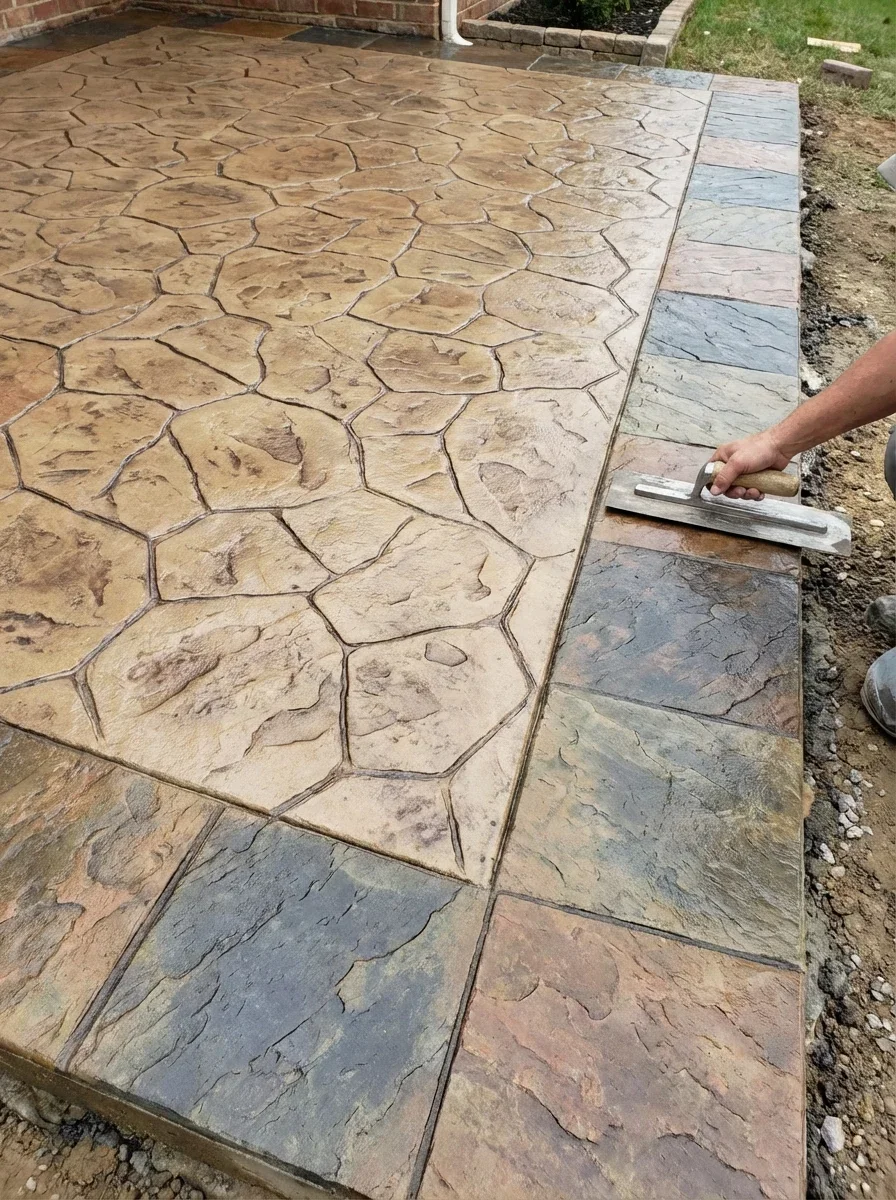
Pattern choice affects both appearance and cost. Simpler patterns with larger repeating units are easier to install. Intricate patterns with smaller details require more time and skill.
Most Requested Patterns in Wisconsin
- Ashlar slate — Random rectangular stone pattern. Clean, modern look. Mid-range cost.
- Cobblestone — Old-world European style. Works well for walkways and borders.
- Flagstone — Natural irregular stone shapes. Popular for patios.
- Herringbone brick — Classic brick layout. Common for driveways and walkways.
- Wood plank — Mimics wood boards. Trending for patios and pool decks.
The stamp pattern itself does not dramatically change the cost — it is the number of colors, border treatments, and hand-finishing details that move the price up.
What Goes Into the Cost
Concrete Base
Stamped concrete starts with the same base as any other slab: excavation, compacted gravel, forming, and a 4-inch (minimum) pour of concrete. This portion costs $5 to $8 per square foot — the same as a plain slab.
Color
Integral color is mixed directly into the concrete before pouring. It colors the slab all the way through, so chips and wear do not reveal grey concrete underneath. Integral color adds $1 to $2 per square foot.[1]
Color hardener is broadcast onto the surface during finishing. It provides richer color and a harder wearing surface but only penetrates the top 1/8 inch. Cost is similar to integral color.
Stamping and Release Agent
The stamping process itself — pressing patterns into the wet concrete — adds $3 to $6 per square foot in labor. The release agent (powder or liquid) creates the secondary color that settles into the stamp impressions, giving depth and contrast.
Sealing
Every stamped concrete surface needs sealing. The initial seal is typically included in the installation price. You will need to reseal every 2 to 3 years at a cost of $1 to $2 per square foot to maintain the color and protect against Wisconsin's freeze-thaw cycles.[2]
Stamped Concrete vs. Alternatives
| Material | Cost Per Sq Ft | Lifespan | Maintenance |
|---|---|---|---|
| Stamped concrete | $10 - $18 | 25 - 35 years | Reseal every 2-3 years |
| Natural flagstone | $15 - $30 | 50+ years | Re-level occasionally, fill joints |
| Brick pavers | $12 - $25 | 25 - 50 years | Re-sand joints, re-level |
| Concrete pavers | $10 - $20 | 25 - 50 years | Re-sand joints, re-level |
| Plain concrete | $6 - $8 | 25 - 40 years | Seal every 2-3 years |
Stamped concrete gives you the appearance of premium materials at a lower price point. The trade-off is that it requires more regular sealing maintenance and individual damaged sections cannot be replaced the way pavers can.
Wisconsin-Specific Considerations
Freeze-Thaw Durability
Stamped concrete in Wisconsin faces 30 to 50 freeze-thaw cycles per year. The sealer is your first line of defense — it prevents water from penetrating the surface and expanding when it freezes.[3]
Ask your contractor about using air-entrained concrete (4% to 7% air content) for any exterior stamped project. Air entrainment creates microscopic bubbles in the concrete that give expanding ice somewhere to go, dramatically reducing surface scaling.
Salt and De-Icer Damage
Avoid using rock salt or calcium chloride de-icers on stamped concrete, especially during the first winter. These products accelerate surface damage on decorative finishes. Sand for traction is the safest option. After the first year, magnesium chloride-based de-icers are the least harmful chemical option.
Color Fading
UV exposure and weathering will gradually lighten stamped concrete colors over time. Regular resealing slows this process significantly. If fading becomes noticeable after 8 to 10 years, a tinted sealer or fresh coat of stain can restore the original look for $2 to $4 per square foot.
Frequently Asked Questions
- Portland Cement Association. "Coloring Concrete — Integral Color and Color Hardener." cement.org. Accessed February 8, 2026.
- American Concrete Institute. "Guide for Concrete Floor and Slab Construction — ACI 302.1." concrete.org. Accessed February 8, 2026.
- Portland Cement Association. "Freeze-Thaw Resistance of Concrete." cement.org. Accessed February 8, 2026.