
Concrete Slab Cost Per Square Foot
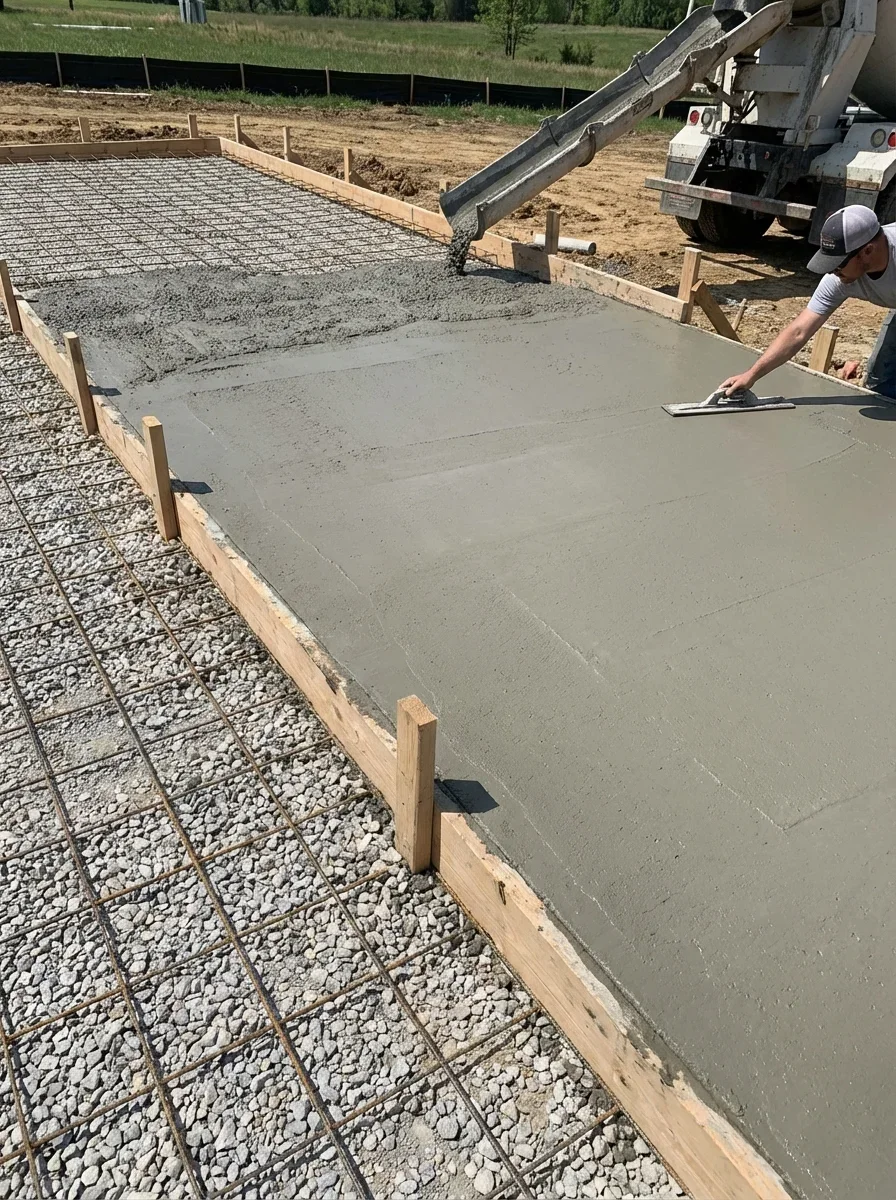
For a standard 4-inch residential slab in Wisconsin, plan on $5 to $8 per square foot installed. That includes site prep, gravel base, forming, wire mesh, pouring, and a broom or float finish.
Thicker slabs (5" to 6") with rebar reinforcement for garages or heavy equipment pads cost $7 to $12 per square foot. Heated slabs with in-floor radiant tubing add another $3 to $6 per square foot on top of the base slab cost.
Slab Cost by Size and Use
| Slab Application | Typical Size | Thickness | Estimated Cost |
|---|---|---|---|
| Shed foundation | 10' x 12' (120 sq ft) | 4" | $600 - $960 |
| Workshop pad | 12' x 16' (192 sq ft) | 4" - 5" | $960 - $1,730 |
| 1-car garage | 12' x 22' (264 sq ft) | 5" - 6" | $1,850 - $3,170 |
| 2-car garage | 24' x 24' (576 sq ft) | 5" - 6" | $4,030 - $6,910 |
| 3-car garage | 36' x 24' (864 sq ft) | 5" - 6" | $6,050 - $10,370 |
| Large pad (2,000 sq ft) | Varies | 4" - 6" | $10,000 - $24,000 |
The frequently asked question — how much does a 2,000 sq ft concrete slab cost — depends heavily on thickness and use. A basic 4-inch slab at that size runs $10,000 to $16,000. A reinforced 6-inch garage or shop floor pushes that to $14,000 to $24,000.
Thickness: Why It Matters More Than You Think
4-Inch Slabs
Four inches is the minimum for any residential slab and works fine for shed foundations, utility pads, and light-use floors. The concrete mix should be a minimum 3,500 PSI for exterior slabs in Wisconsin.[1]
5-Inch to 6-Inch Slabs
Garage floors, workshop slabs, and any surface that will support vehicles or heavy storage should be 5 to 6 inches thick. The cost increase over a 4-inch slab is roughly 25% to 50% in concrete material, but the structural improvement is significant.
A 4-inch slab can support about 4,000 lbs per square foot. A 6-inch slab supports approximately 8,000 lbs per square foot — doubling thickness does not double strength; it roughly quadruples it.
Monolithic vs. Stem Wall Slabs
A monolithic slab has thickened edges (typically 12" to 24" deep) that serve as both the slab and the footing in one pour. This is common for detached garages and shops in Wisconsin, though the thickened edge must reach the 48-inch frost line for any heated or enclosed structure.[2]
A stem wall foundation uses separate footings and a shorter wall, with the slab poured inside. This costs more ($3 to $6 more per linear foot of wall) but provides better frost protection.
Reinforcement Options and Costs
- Wire mesh (6x6 W1.4/W1.4): Standard for most slabs. Usually included in base pricing.
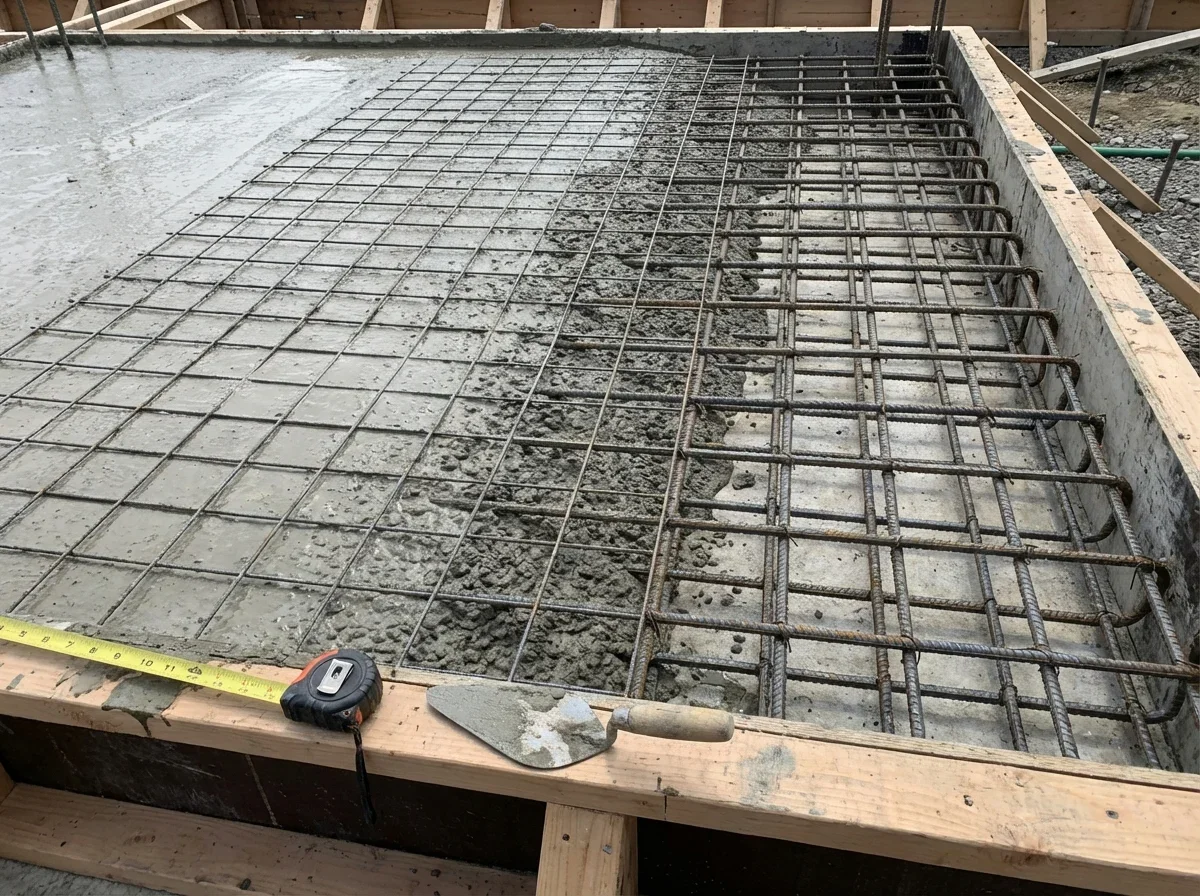
- Rebar (#4 bar, 24" on center): Add $0.75 - $1.50/sq ft. Required for garage slabs and heavy-use areas.
- Fiber mesh: Add $0.25 - $0.50/sq ft. Mixed into concrete to reduce surface cracking. Not a substitute for structural rebar.
- Post-tension cables: Add $2 - $4/sq ft. Used on expansive soils — less common in Wisconsin.
Base Preparation in Wisconsin
Base prep is not a place to cut costs, especially in Wisconsin. The freeze-thaw cycles here will punish any slab that sits on inadequate base material.
You need a minimum of 4 inches of compacted granular fill (Class 5 gravel is standard) beneath any slab. For garages and heavy-use slabs, 6 to 8 inches of compacted base is better. The subgrade beneath the gravel should be compacted to 95% standard Proctor density.[3]
If your site has organic soil, clay pockets, or a high water table, expect additional excavation costs of $500 to $2,000+ depending on how much material needs to be removed and replaced.
Control Joints and Crack Prevention
Control joints should be cut or tooled into the slab within 24 hours of pouring. The general rule is that joint spacing (in feet) should not exceed 2 to 3 times the slab thickness (in inches). For a 4-inch slab, that means joints every 8 to 12 feet.
In Wisconsin, most contractors also recommend isolation joints where the slab meets existing structures, and expansion joints at intervals of 20 to 30 feet for larger slabs.
Permits and Code Requirements
Most Wisconsin municipalities require a building permit for garage slabs, detached structure foundations, and any slab larger than a certain size (often 200 sq ft). Permit fees typically range from $50 to $250.
Your local building inspector will want to verify footing depth, base compaction, and reinforcement before the pour. Plan for at least one inspection visit, which can add a day to your project timeline.
Frequently Asked Questions
- Portland Cement Association. "Concrete Slab-on-Ground Design and Construction." cement.org. Accessed February 8, 2026.
- Wisconsin Uniform Dwelling Code. "Foundation Requirements — SPS 321.15." docs.legis.wisconsin.gov. Accessed February 8, 2026.
- American Concrete Institute. "ACI 360R — Design of Slabs-on-Ground." concrete.org. Accessed February 8, 2026.